Shaping - how to bring text to life
 Av Mikael Jisander
on 29 May, 2024
Av Mikael Jisander
on 29 May, 2024
Writing is fundamentally about transferring information to a reader. When it comes to the kind of commercial texts that a copywriter in a communications agency is responsible for, the aim is often to move the reader one step closer to a purchase. This is where design is a useful stylistic device. Show, don't tell. By dressing the rational arguments in a linguistic costume that stimulates the readers' imagination and emotions, it becomes much easier to get them to absorb the message.
Create a memory image
Every day, we are inundated with thousands of messages competing in our minds. So what is it that makes some messages stick, and some fade away as soon as we have seen them? I would say that it's all about how well the message is presented. Good presentation creates an immediate image in the mind of the recipient, making the message both easier to absorb and something worth remembering.
Design works well in both B2C and B2B, although in B2B there is often an overconfidence that rational arguments are enough. It's not, a message always wins when it's designed.
Clear example
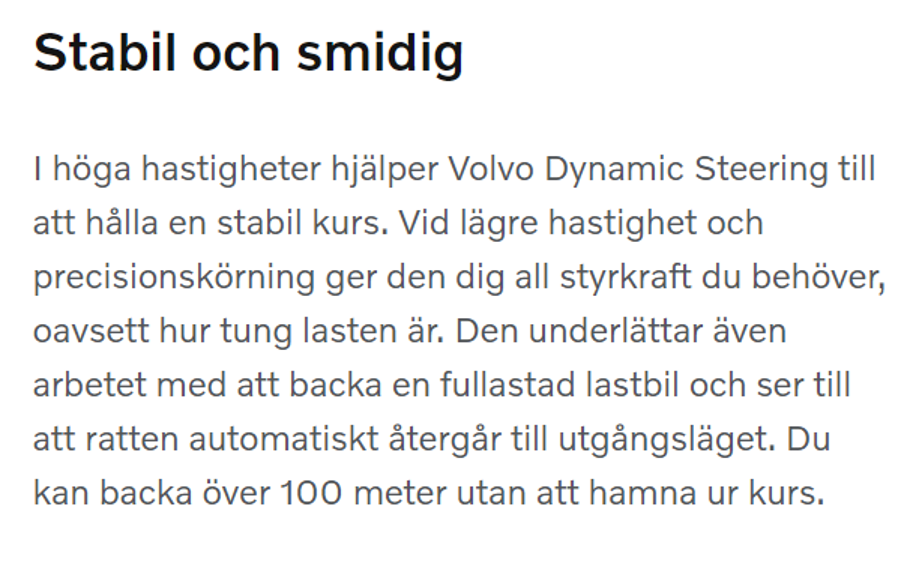
Let's take an example. Volvo Trucks developed the Dynamic Steering concept ten years ago. Here, they present the message in two different ways, undesigned and designed. Which option do you think is more effective?
Informative, unformatted text:
Dramatic, stylized film:

Fill the text with more than information
Yes, but The Epic Split above is a movie, of course it's more fun than text, perhaps friends of order object. True, but the same "trick" can be used to create images in written text. Through well-chosen wording, you can dramatize the text so that readers get more than just information.
Writing that "The truck has dynamic steering for increased stability" is informing. But writing that "So stable you can balance an egg on the dashboard" is to shape. Another example, if you write that "Anders is angry" you are informing. But if you write that "Anders slammed his fist on the table so that the plates flew", you are modeling. Not so difficult, is it? The text becomes so much more vivid, and more fun to absorb.
5 ways to design
Skillful design adds extra quality to the text. Without the reader perhaps understanding exactly how it is done, the design helps to bring both the message and the brand to life. Of course, design should be used in moderation, and no text benefits from being overly colorful. But used in moderation, design is a powerful tool for writing compelling texts. Here are five ways you can use design:
- Use real-life examples to illustrate your point
- Use vivid words and descriptions instead of just facts
- Highlight concrete details that give the reader a picture of what you are describing
- Bring people in, for example through quotes or statements
- Use metaphors and similes
Good luck with the design, and with creating more vivid texts. Customers will appreciate your effort, one hundred percent. As true as the Pope wearing a funny hat.

Related posts

The king of clichés strikes again
The Swedish alphabet has 29 letters. The 39-volume Dictionary of the Swedish Academy contains over 500 000 words. No one knows exactly how many Swedish words are in circulation. In addition to these, new words are constantly being added to describe a changing world. The Swedish language is incredibly rich and has everything needed to put a person's thoughts into words.

Key metrics for newsletters - how to optimize your mailings
Newsletters are one of the most powerful tools for reaching out to customers and building relationships. To really get the most out of your mailings, you need to know what in them works - and what doesn't. In this article, we'll look at the most important newsletter metrics and how to optimize them.

Five clear trends in B2B communication in 2024
If you want to reach out and really touch people with your messages, you need to think twice. It's easy to get stuck in a rut and keep doing what used to work. But the world is changing and sometimes it's a good idea to think about the implications for your company's communication. Here we highlight some of the trends that are currently evident in B2B communication in 2024.